


Stacia K. from Encinitas, California
Purchased Why Cant I Be Rich Instead Of Good Looking Tank Top.


The Somali Football Federation is rebuilding domestic football from governance to grassroots. Here is what that strategy looks like in practice.
A New Playbook for Progress: Examining the Somali Football Federation's Strategy to Professionalize the Game and Attract International Attention
Ali Abdi Mohamed became SFF president in 2023 after a leadership dispute that went through Somali courts and ended at the Court of Arbitration for Sport. FIFA recognized his election in March that year. Since then the federation has opened youth development centres in Baidoa and Kismayo, run CAF coaching courses, launched the country's first women's championship, and put FIFA Forward funding into a new headquarters building. When Mohamed met Gianni Infantino in Paris in July 2024, Infantino said publicly the SFF had made good use of what it had been given.
What that activity looks like from the outside depends on where you are watching from. Domestic fans tracking fixtures via the Download 1xbet apk on their phones see a league that has grown to 12 clubs, broadcasts regularly on Astaan TV and Bile TV, and produces results that feed into continental competition. International observers see a federation that has gone from governance crisis to FIFA commendation in under two years. Neither picture is wrong - they are both parts of the same story of an institution trying to professionalize quickly, with limited resources, in a difficult operating environment.
The SFF is trying to move on several fronts at once - governance reform, infrastructure, youth development, women's football, refereeing standards, and continental competition. For a federation operating with limited staff and inconsistent funding, that is a wide front to hold. The governance dimension SFF is worth examining closely, because without stable governance, every other initiative runs on borrowed time.
Post-2023 reforms at the SFF included the establishment of independent standing committees through the annual General Assembly, specifically designed to reduce the risk of government interference that had destabilized previous administrations. FIFA's recognition of the new leadership was partly conditional on those structural safeguards being in place. The appointment of former election opponent Wiish Yabarow as chairman of the SFF Referee Committee - a move Mohamed described publicly as carrying the same spirit as a handshake at full time - was part of the same drive toward internal stability.
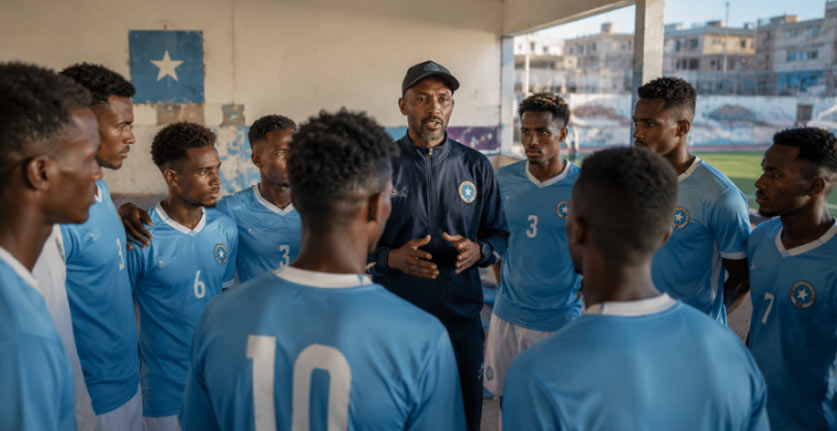
The refereeing reform matters for reasons beyond internal politics. Inconsistent officiating had been one of the most persistent complaints from Somali First Division clubs for years. Credibility problems in domestic officiating damage the product for fans and make it harder to attract broadcast interest. A properly functioning referee committee, with a credible chair and clearer certification standards, is not a headline initiative but it affects the quality of every match played.
The SFF is also working through FIFA Forward funding on staff development - sending federation executives to the FIFA/CIES Football Executive Programme at Nelson Mandela University in South Africa. Bringing administrative capacity up to international standards is slower and less visible than opening a youth development centre, but it determines whether those centres are managed competently over the long term.
The federation's 18 regional branches exist on paper. Making them function in practice - running local competitions, feeding talent into national pathways, distributing federation resources to areas outside Mogadishu - is the work of governance reform at ground level, and it moves at a different pace in different federal states.
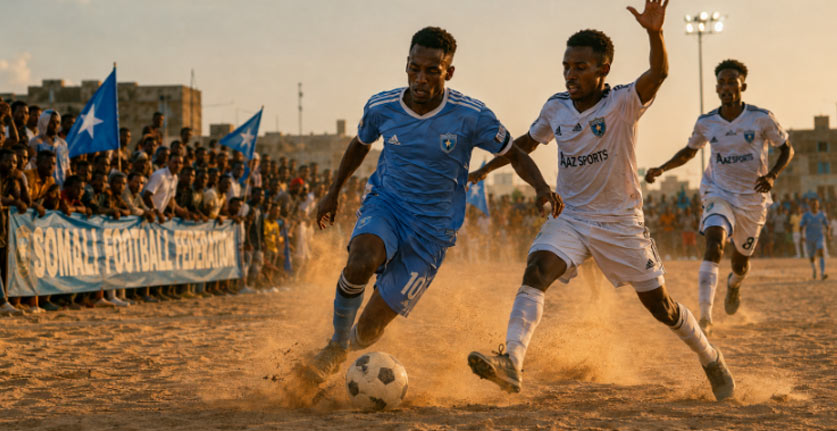
The Somali First Division currently runs with 12 clubs, almost all based in Mogadishu. The league has a promotion and relegation structure connecting it to the Somali Second Division, a domestic cup competition, and a pathway into CAF continental competitions for the champions. Mogadishu City Club took the 2024–25 title. Horseed FC entered the CAF Confederation Cup 2024/25 preliminary draw. Dekedaha FC have twice appeared in the CAF Champions League.
The league table below shows the 2024-25 First Division standings for the top clubs, along with their continental exposure and founding year - context that matters when assessing which clubs are positioned to grow with the league.
The domestic broadcast situation has improved noticeably. Astaan TV, Asal TV, and Bile TV all carry First Division matches. Highlights circulate on YouTube and Facebook the same evening, with Somali-language commentary, reaching the diaspora across Europe, the Gulf, and North America in real time. That digital reach is part of what makes the 1xbet apk relevant for younger Somali fans - the infrastructure to follow the game digitally now exists in a way it did not five years ago.
|
Club |
Founded |
2024–25 Position |
CAF Appearances |
|
Mogadishu City Club |
1963 |
Champions |
CAF Champions League |
|
Horseed FC |
1971 |
3rd |
CAF Confederation Cup 2024/25 |
|
Dekedaha FC |
1973 |
4th |
CAF Champions League × 2 |
|
Elman FC |
1996 |
5th |
CAF qualifiers |
|
Gaadiidka FC |
1976 |
6th |
Domestic only |
|
Badbaado FC |
— |
Mid-table |
Domestic only |
One structural issue the league has not fully resolved is the concentration of clubs in Mogadishu. Twelve clubs, most sharing two stadiums in the same city, creates a compressed competitive environment. Regional clubs outside the capital are underrepresented, which narrows the league's national footprint and limits its appeal to audiences in Jubbaland, Hirshabelle, and Puntland. The SFF's plan to open development centres in all federal states is partly an attempt to address this over time - building the youth infrastructure in regions that might eventually sustain competitive clubs at the top level.
The opening of Somalia's first Youth Football Development Centre in Baidoa on February 13, 2025, and the second in Kismayo a week later, were the most visible steps in the SFF's youth strategy. Both centres train players aged under-9 to under-16 alongside school schedules. Both have CAF-certified coaching staff. Both are intended as prototypes for a national network across all federal states.
SFF president Ali Abdi Mohamed was direct at the Baidoa launch: players need structured training from the age of nine, they need coaches who know what structured training means, and those coaches need formal certification. The CAF License D course for 30 coaches run alongside the Baidoa opening was a practical response to the last point - certifying coaches already working in the region rather than waiting for a new generation to come through a pipeline that does not yet fully exist.
The under-17 national team's qualification for the CAF Under-17 Africa Cup of Nations in Morocco in 2025 - their second consecutive AFCON appearance - showed that the youth pathway is producing results at international level. Several players in the squad were identified through regional tryouts the SFF has been running since 2019. The pattern is starting to hold: community-level coaching produces players, regional tryouts identify them, national youth squads develop them.
What is missing from the current setup:
On March 8, 2024, women's football was played officially in Mogadishu for the first time under SFF governance - a futsal match to mark International Women's Day. By November 2024, the first full women's football tournament ran under the theme Beyond Barriers, with eight teams competing over two weeks. In October 2025, the national women's team, the Ocean Starlets, travelled to Djibouti for their first international fixtures.
Each of those steps happened faster than similar milestones in comparable markets. The SFF's willingness to move on women's football - despite the cultural and logistical obstacles that exist in Somalia - reflects a calculated decision that FIFA and CAF both prioritize women's football development in their funding and recognition frameworks. That pragmatism does not make the initiative less real: the players competing in those tournaments were not symbolic; they were footballers who had been training with no official structure to compete in.
The following steps are publicly confirmed as part of the SFF's women's football programme going forward:
The women's programme is the area of the SFF's work where ambition is furthest ahead of infrastructure. That gap will close more quickly if the domestic league launches and gives players a regular competition to prepare for.
Somalia's football re-engagement with the continental and global game has been gradual and largely on the federation's own terms. The national team returned to CAF Champions League and Confederation competition in 2019 after a 30-year absence. The senior men's squad is now participating in FIFA World Cup 2026 qualifying in Group G alongside Algeria, Botswana, Guinea, Mozambique, and Uganda - though home matches cannot yet be played on Somali soil, forcing the team to use neutral venues abroad.
Sixteen of the 26 players in the current senior squad were born outside Somalia. The diaspora connection gives the Ocean Stars a genuinely international player pool - Somali communities in Europe, North America, and the Gulf have produced players who grew up in professional football environments and choose to represent Somalia. Managing that pool, integrating diaspora players with domestically developed ones, and building team cohesion across players who grew up in different countries and football cultures is one of the more specific challenges the coaching staff navigate.
Fans following the senior team's qualifying campaign through the Download 1xbet apk are watching a squad that looks different from any previous generation of Ocean Stars - more experienced internationally, more technically developed, but still building the collective identity that sustained campaigns require. The SFF's job is to create the conditions where that process can develop without the governance interruptions that derailed previous eras.
You must be of legal age and in no violation of local or federal laws while viewing this material.
We do not support misuse of alcohol, including excessive consumption, binge drinking, or drinking and driving. It has been proven that excessive drinking can cause serious physical harm.
Please drink responsibly!
An error occurred while trying to submit the form - we'll do our best to fix it ASAP.
My bad =(

Stacia K. from Encinitas, California
Purchased Why Cant I Be Rich Instead Of Good Looking Tank Top.
 Verified by Provely